

Airborne Early Warning: The temporary solution!
Tim Senior looks at the last Shackleton variant, the AEW2. Pictures by Terry Senior and Gary Parsons
In the late 1960s the British Armed Forces suffered from a large series of defence cutbacks, the majority of which were part of the planned withdrawal from bases to the east of Suez. Amongst the cuts were plans to reduce the Royal Navy aircraft carrier fleet, which left them with only one fully operational carrier capable of operating the Phantom FG1. At the same time, future plans for further large carriers fell foul of these cuts, leaving the Navy with its small air wing, including a small fleet of Gannet AEW3 Airborne Early Warning aircraft. At this time the RAF did not possess any AEW capability at all - the need for an AEW aircraft to cover the North Sea and the Northern Atlantic, around the United Kingdom was deemed to be of the utmost importance.
A decision was made to find a short-term solution to fill the capability gap. At that time there were several airframes that were either available, or in development; however plans were drawn up to find a low-cost ‘off-the-shelf’ solution utilising an existing airframe, which would be a short-term measure until a new purpose-built aircraft was ready. At about the same time, towards the end of 1969, the Nimrod MR1 had begun to enter service with Strike Command, initially with the RAF’s UK-based Maritime Reconnaissance units, thus replacing its predecessor, the Shackleton MR3.
|
Last
of the line
|
 |
The majority of the UK-based MR units were, at this stage, equipped with the MR3 Phase 3, which had been fitted with the Bristol Siddeley Viper jet engine in the outboard engine nacelles. This modification had certain advantages due to the increasingly heavy equipment fitted to the Shackleton after several upgrades - however it had effectively helped to use up the majority of each of the remaining airframes fatigue lives. That effectively ruled these airframes out all together, but the RAF still had several units flying the earlier Shackleton MR2. Although the Nimrod was rapidly taking over from the Shackleton, a decision had been made to continue using the Shackleton in the Search and Rescue standby role until the Nimrod was deemed to be fully operational.
The Shackleton MR2s were operated with a number of units at various bases, which at the start of 1970 included the following: No 204, based at RAF Ballykelly, Northern Ireland, which remained here until it disbanded on 1 April 1971 and reformed later the same day at RAF Honington, Suffolk; No 205 at Changi, Singapore, which disbanded on 31 October 1971 - although most of its aircraft were retired, four aircraft went on to join 204 Squadron; the final unit was No 210, based at Sharjah, which disbanded on 15 November 1971. Some of the aircraft operated by this unit were ex-Maritime Operational Training Unit (MOTU) T2s modified to MR2 Phase 3 standard, and amongst these airframes were two aircraft that would find useful roles later, namely WL787 and WR967. This left only 204 Squadron operating the few remaining Shackletons by the end of 1971, the unit having a complement of twelve MR2s, with a handful of others remaining in Maintenance Units.
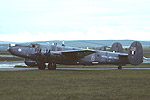
With a suitable and cheap airframe found, plans were then drawn up for these remaining Shackleton airframes to be converted to AEW2 standard. The airframe records were duly checked to find sufficient airframes with enough fatigue life left to perform the task once they were converted. To convert the Shackleton into an AEW2 firstly involved removal of all the maritime reconnaissance equipment, which included the ventral radome underneath the rear fuselage. The aircraft was then modified to accept the AN/APS-20 radar from the Gannet AEW3, this being fitted into the ex-Gannet radome, which had be fitted under the cockpit cabin, just ahead of the weapons bay. The radar from the Gannets was by then almost as old as the Shackleton itself, being simply an updated version to the one fitted to the AEW version of the Douglas Skyraider. Inside the fuselage the relevant equipment stations for the radar operators and other personnel including the Tactical Co-ordinator (TACCO) were fitted - the galley was kept, and stories of numerous culinary delights served up on long missions abound.
With the conversion process underway, the first prototype AEW2, WL745, made its first flight from Hawker Siddeley’s airfield at Woodford on 30 September 1971. The unit chosen to operate the aircraft was at the time a recent casualty of the withdrawal from the Middle East, 8 Squadron having disbanded as a Hunter FGA9 unit at Muharraq, Bahrain. It was reformed at Lossiemouth on 1 January 1972, although immediately moved to Kinloss temporarily while runway work was carried out at Lossiemouth. While the prototype was undergoing trials and other airframes were undergoing conversion at either Woodford or Bitteswell, the unit operated what would eventually become a total of five MR2Cs for crew training. The first of these airframes, WL787, arrived on 1 November 1971 and was initially named ‘Mr McHenry’, although this was changed to ‘Dylan’ at some point. The aircraft served for a couple of years before it was withdrawn from use in January 1974, and used for fire training at Lossiemouth. Other MR2s used by the unit included WR967, delivered on 23 November 1971, and named ‘Zebedee’, although it subsequently suffered some damage in an accident on 7 September 1972. After this, it was withdrawn from use, and had its wings and rear fuselage removed becoming an aircrew procedures trainer with the unit. It was cunningly renamed ‘Dodo’, and was eventually saved from the scrapman in 1991, and is now stored at Paphos International Airport, Cyprus. WL738 was allocated on 8 March 1974, and flown by the unit until retired in late 1977, becoming the gate guardian at Lossiemouth on 5 April 1978, until the policy of having only one gate guard per airfield came into effect in 1989. After this, it was duly tendered for sale and was scrapped in March 1990. It was replaced in November 1977 by WG556, straight from storage at St Athan, joining another trainer, WL801, which had arrived in August 1974. After it was retired in late 1980, WG556 went to the fire dump at Lossiemouth in early 1981, and was removed as scrap in July 1982. WL801, meanwhile had been dispatched to Cosford in June 1979, initially for ground instructional use by No 2 School of Technical Training, before being offered for tender during the summer of 1984, the aircraft being scrapped soon afterwards. The final MR2C used was WL798, which was transferred to the squadron from Cosford for spares recovery during January 1987. After performing this vital task, it was eventually moved onto the dump until being offered for sale. It was finally scrapped in early 1991, although the nose section was reportedly kept by the scrapyard owners and was last heard of stored in Elgin, during the mid 1990s.
The first
AEW2 delivered to the squadron came on 11 April 1972 in the shape of WL747
- the unit had had a further seven delivered by the end of the year. The
final aircraft to be delivered was the prototype conversion, WL745, which
arrived after completing trials on 17 September 1973. The AEW2’s main
role was to track unidentified radar returns flying within the UK air
defence region, and direct Lightnings, Phantoms and eventually Tornado
F3s to intercept and identify. The aircraft were not only confined to
the vagaries of the English weather system as aircraft often ventured
further afield on detachments to RAF Luqa, Malta and Akrotiri, Cyprus.
In the late 1970s the fleet underwent major overhauls and had new main
spars fitted, however the perilous axe of 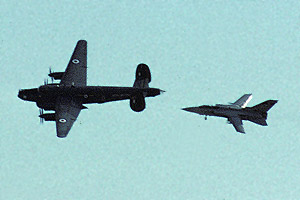 defence
cuts struck in 1981 with the highest-hour airframes being retired. Four
aircraft went for fire and crash rescue training at the following locations:
WL741 to the Central Training Establishment (CTE) at Manston on 29 May
and WL745 to the Fire Fighting and Safety School (FF&SS) Catterick
on 13 July; WL754 had arrived at Valley by August, while WL793 was simply
towed across to the dump at Lossiemouth during the summer. Thankfully
the two remaining airframes, WL795 and WR960, were to suffer a slightly
less brutal retirement, as WL795 was flown to St Mawgan in November 1981,
where despite being allocated for fire training, was saved and placed
on display as a gate guardian. WR960 was delivered to Cosford in November
1982 and after being dismantled for road transport went on display at
the Manchester Museum of Science and Industry in early 1983.
defence
cuts struck in 1981 with the highest-hour airframes being retired. Four
aircraft went for fire and crash rescue training at the following locations:
WL741 to the Central Training Establishment (CTE) at Manston on 29 May
and WL745 to the Fire Fighting and Safety School (FF&SS) Catterick
on 13 July; WL754 had arrived at Valley by August, while WL793 was simply
towed across to the dump at Lossiemouth during the summer. Thankfully
the two remaining airframes, WL795 and WR960, were to suffer a slightly
less brutal retirement, as WL795 was flown to St Mawgan in November 1981,
where despite being allocated for fire training, was saved and placed
on display as a gate guardian. WR960 was delivered to Cosford in November
1982 and after being dismantled for road transport went on display at
the Manchester Museum of Science and Industry in early 1983.
The Shackletons were regular participants in both British military and NATO maritime exercises, regularly operating with the Royal Navy, the squadron developing a close inter-service relationship with the aircraft carrier HMS Invincible. In December 1986, with no signs of improvement in the Nimrod AEW3 radar trials, the entire programme was finally cancelled, leaving 8 Squadron to drone on with its six remaining Shackletons. The Conservative Government finally announced the aircraft's successor in 1988 in the form of the Boeing E-3D, or Sentry AEW1 as it would be known to the RAF. During 7-8 August 1988, 8 Squadron held a rather unique families' day, which attracted some foreign aircraft and aircrew that served in units with the No 8 in the title. The Squadron's newest acquisition, a Chipmunk T10 was also on display, it being used for aircrew tailwheel training.
The trusty old Shack’s career was now drawing to a close, and its retirement finally came a step closer on 5 January 1990 when the first Sentry AEW1, ZH101, made its first flight. Sadly just under a year before retiring, the unit suffered the loss of WR965 on 30 April 1990 when it crashed into a hillside in foggy conditions on the Isle of Harris off the West coast of Scotland, all ten crew including the Commanding Officer being killed. As deliveries of the E-3Ds increased, parts of 8 Squadron moved down to work up on the new aircraft, becoming 8 Squadron (South), the older unit becoming 8 Squadron (North). In June 1991 the last five airframes were flown down to Waddington, three aircraft having performed a flypast over Buckingham Palace to mark the Queen's official birthday.
Of the five remaining aircraft, WL756 was allocated to St Mawgan for fire training and some components were retained for the gate guardian WL795. It was eventually scrapped, although its nose was saved and is now kept at the Caernarfon Air Museum. The four remaining airframes were put up for auction by Sotheby’s and made available for viewing at Waddington - the auction took place on 3 July 1991, and the Shackleton Preservation Trust secured two airframes, WL790 and WR963, which were flown to Coventry on 10 July. The other two aircraft, WL747 and WL757, were purchased by Savvas Constantinides, and were ferried to their new home at Paphos Airport on the island of Cyprus, were they have remained ever since, lapsing into a state of semi-dereliction. Both airframes were moved with RAF assistance during the summer of 2006 to make way for new development at the airport, the new airport management stating they have a secure future. Meanwhile, the pair saved by the Shackleton Preservation Trust have fared slightly better, both being given a home thanks to Air Atlantique. WR963 has been maintained in ground-running condition and has also been partly restored to look like an MR2, while Air Atlantique took on the task of flying WL790 over to the United States in September 1994. After operating the aircraft on the airshow circuit, it might undertake one final flight back to the UK at some point in the future. So, what began life as an interim AEW solution, actually went on to serve the RAF well in this role for a total of nineteen years, and the Shackleton itself finally bowed out of service after a total of forty years.
Several other Shackleton’s survive around the United Kingdom; these include a small number of MR3s, including WR971 at West Walton, Norfolk, while both WR974 and WR982 are kept at the Gatwick Aviation Museum, Charlwood, Surrey. Another airframe, WR985, is kept at Long Marston by the Jet Aviation Preservation Group, while another well-known airframe, XF708, is cared for by the Imperial War Museum at Duxford. Two nose sections survive including T4 VP293, which is kept at the City of Norwich Air Museum, and WG511.
Several MR3s also survive in the country that became the only export customer, namely South Africa, which purchased a modest total of eight. One of these, 1722, is maintained in flying condition by the SAAF Museum. Another former airworthy museum aircraft, 1716, sadly sits in the Sahara desert slowly disappearing under the sand. The museum also has 1720 at Ysterplatt AFB, while 1721 is kept at the main AF museum at Swartkop AFB. 1717 is preserved in Kwazulu Natal, and the most spectacular example must be 1723 painted in Coca-Cola colours on top of 'Vic’s Viking' garage on a freeway near Johannesburg, it being used in an exchange for a Vickers Viking that formerly occupied the rooftop!
Home | Airshows | The Hangar | Nostalgia | Links